

26-10: Outline
A look back to the weeks of April 27 and May 4, with help from sketching


Welcome back to 1910 & Beyond, your regular briefing on the ever-evolving world of appellate law in Houston and beyond. Each post spotlights notable developments from Houston’s two courts of appeals—the First and Fourteenth—as well as from other state and federal appellate courts across Texas and nationwide, while also sharing practical tips on oral and written advocacy. I hope you find these posts useful to your practice and your understanding of what’s happening in Texas appellate law.
To those who have already subscribed, thank you. If you haven’t yet, I hope you’ll consider joining us!
Opening Statement
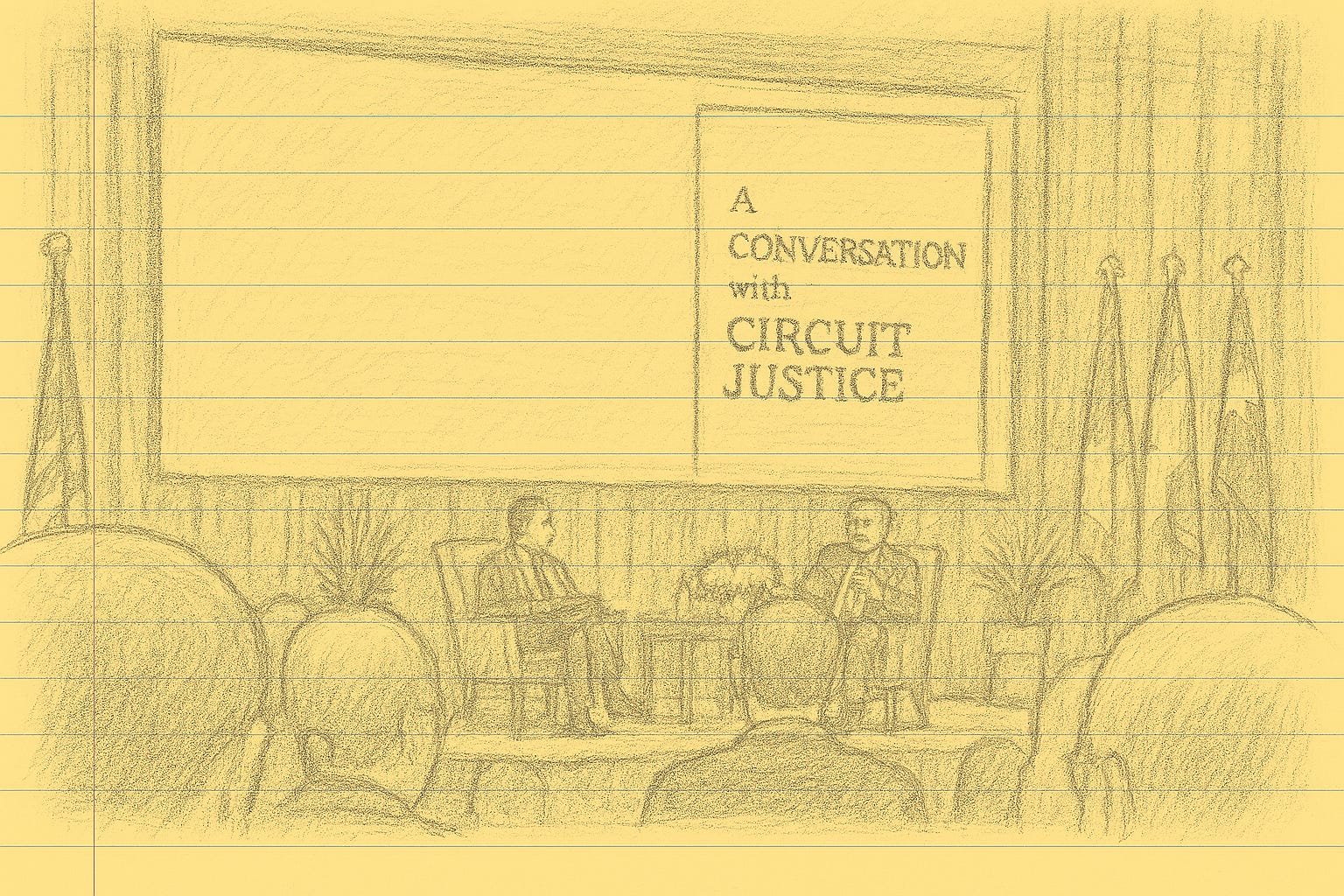
Last week, I attended the annual Fifth Circuit Judicial Conference. As always, it was a terrific opportunity to catch up with friends and colleagues from the bench and bar. And the programming, also as always, was excellent.1
One highlight was a conversation with Justice Samuel Alito, who serves as the Circuit Justice for the Fifth Circuit. Interviewed by his former law clerk Aaron Nielson—who did an excellent job as moderator—Justice Alito covered a wide range of topics: his upbringing in New Jersey, what he looks for in law clerks, how the role of a federal judge has changed since he joined the Third Circuit and later the Supreme Court, and even his dog’s separation anxiety after the move to Washington, D.C.
But the part that most caught my attention was his discussion of writing process.
Justice Alito explained that when he is preparing a majority opinion, he begins by giving his law clerk the broad shape of the opinion. But he doesn’t then simply send the clerk off to draft. Instead, he first asks for a detailed outline. The point, as Justice Alito described it, is to make sure the opinion is structured the way he wants before the drafting begins.
I found myself nodding along. Needless to say, I’m not drafting majority opinions for the Supreme Court of the United States. But the basic discipline is the same one I have tried to follow throughout my appellate practice. When I drafted briefs myself, I always started with a detailed outline. And now that I more often supervise the drafting process, I insist that others do the same. That way, the first draft isn’t some mere thought experiment; it’s the execution of a carefully-thought-through analytical path.
That practical preference reflects a larger point about legal writing. A good outline isn’t just some pre-drafting exercise. It’s a test of reasoning. If the outline doesn’t work, the brief won’t work. And if the writer can’t explain the sequence of the argument before drafting begins, the finished product is unlikely to become clear by accident.
Whenever I talk about legal writing, I usually begin with the same overarching principle: The best legal brief is a logical, easy-to-follow brief. My goal in every brief is straightforward—if a judge reads the brief only once, the judge should walk away understanding the basic points I’m trying to convey and why those points matter.
That kind of clarity takes work. It rarely comes from stream-of-consciousness drafting. It requires discipline on the front end, including the kind of careful outlining that too many lawyers skip. Without that structure, a brief may start strong, only to meander through the middle and arrive at a conclusion that feels less clarifying than confusing.
The usual response I hear is: “I don’t have time to outline.” To which I would respond—borrowing Justice Alito’s phrasing from an infamous moment—“Not true.” Time spent outlining saves time drafting. It reduces the amount of staring at a blank screen, wondering what the next paragraph should say. It reduces the amount of rewriting required when the first draft reveals that the argument’s structure was never settled. And most important, it gives the reader what every good appellate brief should provide: a clear path from premise to conclusion.
Like any other Justice, Justice Alito certainly has his jurisprudential dissenters. But on this point, anyone who cares about the craft of legal writing should vote to affirm. Before the words must come the structure. And before a brief can persuade, it must make sense. That is the promise of a good outline.
Feature

In re Novartis Pharmaceuticals Corp., No. 15-25-00207-CV (Brister, C.J., Field, Farris, JJ.) (orig. proceeding): By divided vote, the Fifteenth Court denied Novartis’s mandamus petition challenging the trial court’s refusal to dismiss a Texas Medicaid Fraud Prevention Act qui tam suit. Novartis’s motion raised two substantial constitutional arguments: that Health Selection Group lacked standing because it wasn’t injured by the alleged Medicaid fraud, and that the Act’s qui tam provisions violate the Texas Constitution’s separation-of-powers clause.
Writing for the majority, Justice Farris—joined by Justice Field—declined to reach those merits questions. While Novartis’s constitutional challenges were “compelling,” ordinary appeal remains adequate. The cost and burden of discovery didn’t, by themselves, justify mandamus, nor did the case present the kind of procedural distortion or overwhelming burden that required immediate intervention. The issues thus were better left for an appeal from summary judgment or trial with a developed record.
The majority’s point is a familiar but important one: Mandamus isn’t just error correction on an accelerated schedule. Even “weighty” constitutional issues do not automatically justify mandamus review, and the ordinary cost and delay of litigation usually won’t make appeal inadequate. Or—as Justice Farris aptly put it—“[m]andamus relief is strong medicine that should be used sparingly.”
Chief Justice Brister dissented at length, viewing the case differently because of its scale and its public-law stakes. In his view, this wasn’t some routine “cost and delay” case. It was a mass-tort-like proceeding involving potentially millions of transactions, substantial public resources, and antecedent questions of subject-matter jurisdiction. He would have reached the standing and separation-of-powers issues—both of which, in his view, favored Novartis—especially given two Supreme Court Justices’ prior invitation for the Fifteenth Court’s views in this very case.
The Justices’ disagreement over the availability of mandamus relief is what makes this opinion—even if it’s not the last word on the subject2—worth sketching out. The majority and dissent aren’t merely arguing about the undoubted “compelling” nature of the constitutional issues; they’re arguing about when it’s appropriate for an appellate court to take up the pencil at all. For lawyers pursuing mandamus relief, the opinion is a reminder that the “no adequate remedy by appeal” section can’t be an afterthought: It must be outlined with the same care as the merits, showing not only why the trial court was wrong, but also why waiting for ordinary appeal would defeat the point of review.
N.B.: Mandamus isn’t just a faster appeal, so the outline must start with why appeal is inadequate. Even the sharpest constitutional argument may stay in the sketchbook if the petition can’t persuasively show why the appellate court must intervene now.
1910
Orders and Opinions
And now, to our local courts here in Houston. Below are brief outlines of notable opinions and orders from the First and Fourteenth Courts.

1COA
Holloman Holdings Corp. v. Starr Indemnity & Liability Co., No. 01-24-00704-CV (Rivas-Molloy, Johnson, Dokupil, JJ.): Reversing a Rule 91a dismissal, the First Court held that Holloman’s pleadings didn’t establish as a matter of law that Starr was prejudiced by allegedly late notice of a builder’s-risk insurance claim. Rule 91a barred consideration of Starr’s answer exhibits, which were not part of Holloman’s pleadings. Holloman alleged that Starr’s adjuster conducted an extensive investigation and made a settlement offer, so the pleadings didn’t conclusively show that Starr was unable to investigate the loss.
In re Universal Protection Service, LP, No. 01-26-00174-CV (Rivas-Molloy, Johnson, Dokupil, JJ.) (orig. proceeding): Conditionally granting mandamus relief, the First Court directed the trial court to vacate its order denying relators’ motion for leave to designate a responsible third party and to grant the motion. Section 33.004 required leave because relators filed the motion more than 60 days before trial and no party timely objected—an error for which relators lacked an adequate appellate remedy.
Brys v. Cobb, No. 01-24-00726-CV (Rivas-Molloy, Guiney, Morgan, JJ.): Vacating the challenged orders and dismissing the appeal, the First Court held that the trial court lacked jurisdiction to grant a new trial or declare a domesticated California judgment void after its plenary power expired. Brys’s Uniform Enforcement of Foreign Judgments Act filing made the California judgment enforceable as a Texas judgment, and Cobb’s challenge came more than a year later—well outside the 30-day plenary-power window. Because the post-plenary-power orders were void, the domesticated California judgment remained intact.
Choudhri v. Lee, No. 01-24-00323-CV (Rivas-Molloy, Gunn, Caughey, JJ.): Affirming summary judgment for Lee on a breach-of-guaranty claim, the First Court held that Lee’s custodian declaration, note, and guaranty conclusively established the debt, default, and Choudhri’s payment obligation. The trial court didn’t abuse its discretion by admitting Lee’s summary-judgment evidence, rejecting Choudhri’s various evidentiary objections. The court also rejected Choudhri’s release defense and counterclaim because the settlement agreement he relied on concerned a separate loan and did not mention or clearly cover the loan at issue.
Foley & Lardner LLP v. Dernick, No. 01-25-00109-CV (Rivas-Molloy, Gunn, Caughey, JJ.): After demanding arbitration at the case’s outset, did a law firm nonetheless waive their right to compel arbitration by pursuing and initially winning dismissal under the Texas Citizens Protection Act?
Majority (Gunn, J.): No. Reversing the order denying arbitration, the First Court held that the firm did not substantially invoke the judicial process in a way that clearly showed waiver. The firm demanded arbitration before answering, moved to compel shortly afterward, preserved arbitration in its TCPA motion, took no discovery, and asserted no affirmative claims for relief. “The issue strikes us as a close one, but close cases go to arbitration” given the heavy burden to show waiver.
Dissent (Rivas-Molloy, J.): Yes. The firm substantially invoked the judicial process because, despite knowing about the arbitration agreement from the outset, it didn’t set its motion to compel for hearing until after first obtaining TCPA dismissal with prejudice and an attorney’s-fee award, only to later lose that ruling on appeal. The TCPA motion required the clients to marshal evidence and resulted in a merits dismissal with res judicata implications, a remedy the firm could not obtain in arbitration. And even assuming prejudice remains required, the clients were prejudiced through years of delay, nearly $84,000 in fees, and premature disclosure of their proof.
Clontz v. Kuntze, No. 01-24-01013-CV (Caughey, J.) (order): Denying temporary relief pending appeal, the First Court held that Clontz could not use Texas Rule of Appellate Procedure 29.3 to suspend Kuntze’s possession rights under an existing divorce decree after the trial court dismissed her modification suit for want of prosecution. Rule 29.3 applies to interlocutory appeals, and this appeal was from a final dismissal order. In any event, the requested relief would alter—not preserve—the status quo because the divorce decree remained in effect and unmodified.
14COA
eCORP Investment Partnership, L.P. v. eCORP International, LLC, No. 14-23-00032-CV (Wilson, Hart, McLaughlin, JJ.): Affirming in part and reversing in part, the Fourteenth Court held that appellees did not conclusively establish summary-judgment grounds defeating eCIP’s breach-of-contract and alter-ego claims based on a later restructuring agreement. The Loan Agreement required any modification to be signed by each party, and the restructuring agreement didn’t mention the Loan Agreement or show execution by all necessary parties. To the extent the trial court granted summary judgment based on issue preclusion, that was error because the issues raised in the related arbitral proceeding were different. As to Bellinger, fact issues existed on alleged breaches of the duties of loyalty and full disclosure arising from his role as escrow holder while serving as eCORP’s general counsel. But summary judgment was proper on theories based solely on that dual role and on the duty to conserve collateral because the parties agreed to the arrangement and there was no evidence the collateral was lost or damaged.
In re Costco Wholesale Corp., No. 14-25-00955-CV (Wilson, Hart, McLaughlin, JJ.) (orig. proceeding): Conditionally granting mandamus relief, the Fourteenth Court held that the trial court abused its discretion by authorizing pre-suit Rule 202 discovery without evidence supporting the required findings. A verified Rule 202 petition and counsel’s declarations were not competent evidence, and the possibility of federal removal didn’t justify Rule 202 discovery before suit. The court also rejected the need to identify potential parties as a sufficient basis because the petitioner could use ordinary discovery to this end (and limitations wasn’t looming). Finally, the petitioner didn’t prove that the likely benefit outweighed the burden or expense.
GR Lift, L.P. v. Odessa Pumps & Equipment, Inc., No. 14-24-00370-CV (Wilson, Hart, Boatman, JJ.): Affirming as modified, the Fourteenth Court upheld a declaration that Odessa didn’t intentionally act in bad faith to reduce an earnout payment, concluding that the GR parties bore the burden on both their breach counterclaim and Odessa’s mirror nonliability declaration. But Odessa could not use the Declaratory Judgments Act to recover attorneys’ fees for successfully defending the GR parties’ breach counterclaim when those fees otherwise would be unavailable. Odessa also wasn’t entitled to prejudgment interest on Chapter 38 attorney’s fees because fees awarded for prosecuting or defending a claim are not damages subject to equitable prejudgment interest.
Gulf Coast Lease Service, Inc. v. Rise Petroleum Investments LLC, No. 14-25-00006-CV (Jewell, McLaughlin, Antú, JJ.): Reversing a dismissal for want of prosecution, the Fourteenth Court held that Gulf Coast’s verified motion to reinstate supplied a reasonable explanation for missing the trial court’s deadline to move to retain or seek default judgment. Gulf Coast couldn’t obtain default judgment until it received and filed the Secretary of State’s Whitney certificate, and counsel’s failure to calendar the dismissal deadline after misplacing a reminder showed accident or mistake, not conscious indifference.
Solomon v. The Law Office of Keith M. Harris, No. 14-25-00029-CV (Wise, Hart, Boatman, JJ.): Reversing and remanding a take-nothing judgment in a legal-malpractice case, the Fourteenth Court held that excluding all of the plaintiffs’ causation and damages evidence under Texas Rule of Civil Procedure 193.6 amounted to an improper death-penalty sanction because it precluded them from presenting the merits of their case. Because the trial court didn’t first test or explain why lesser sanctions would be inadequate, and the exclusion led directly to a directed verdict, the error probably caused an improper judgment.
McNair v. Palmetto Trust Co. LLC, No. 14-25-00072-CV (Jewell, Wilson, Boatman, JJ.): Affirming the denial of a plea to the jurisdiction and Texas Citizens Protection Act motion, the Fourteenth Court held that the probate court had jurisdiction over trust-related claims and could exercise pendent or ancillary jurisdiction over closely related non-trustee claims. The trustee’s fiduciary-duty claim fell within the Estates Code provision for actions by or against a trustee; and the remaining challenged claims arose from the same alleged conduct involving employment agreements, compensation changes, and concealment, giving rise to ancillary jurisdiction. The TCPA didn’t apply because the challenged claims were based on alleged fiduciary and contractual misconduct, not on Cary McNair’s earlier guardianship petition, which served only as background context.
Worldvue Connect, Inc. v. Stritz, No. 14-25-00315-CV (Jewell, Wilson, Boatman, JJ.): Affirming the denial of Worldvue’s motion to compel arbitration, the Fourteenth Court held that the employee handbook didn’t create an enforceable arbitration agreement. The arbitration provision was part of the handbook, and the handbook gave Worldvue an unrestricted right to amend its policies—including the arbitration provision—making the arbitration promise illusory. The handbook also expressly disclaimed any intent to create a contractual relationship, defeating the offer-and-acceptance requirements for a valid arbitration agreement.
Rincon v. Lexington Insurance Co., No. 14-25-00063-CV (Christopher, C.J.; Hart, Antú, JJ.): Affirming a Rule 91a dismissal, the Fourteenth Court held that judgment creditors of an insured lacked standing to sue the insurer directly under first-party property policies. The policies covered the insured’s interest in property, including property of others in the insured’s care, custody, or control, but did not clearly confer a direct enforcement right on third parties or judgment creditors. Because the Rincons were not insureds, beneficiaries, assignees, or third-party beneficiaries, their contract, bad-faith, Insurance Code, and declaratory-judgment theories all failed for lack of standing.
Energy Transfer LP v. Purland, No. 14-25-00110-CV (Christopher, C.J., Hart, Bridges, JJ.): Reversing and remanding, the Fourteenth Court held that a pipeline technician who frequently maintained and repaired valves on interstate natural-gas pipelines belonged to a class of transportation workers exempt from arbitration under Section 1 of the Federal Arbitration Act. The parties’ agreement that the FAA governed, and their broad delegation clause, didn’t allow an arbitrator to decide that nondelegable FAA-exemption issue. But the remaining arbitrability issues—including whether the Texas Arbitration Act applies to the personal-injury and wrongful-death claims and any other enforceability defenses—fell within the delegation clause, so the trial court had to compel arbitration of those threshold issues and stay the litigation.3
Gengler v. University of Houston-Downtown, No. 14-25-00138-CV (Jewell, Wilson, Boatman, JJ.): Affirming dismissal with prejudice, the Fourteenth Court held that a former University of Houston-Downtown dean did not plead facts affirmatively showing a waiver of UHD’s sovereign immunity for claims arising from an alleged breach of an employment-related settlement agreement. The Lawson settlement-agreement exception didn’t apply because the dean didn’t plead or support facts showing that the agreement settled a claim for which immunity had already been waived, and his extra-contractual tort claims didn’t fit the ultra vires exception. Nor did dismissal with prejudice violate his due-process rights or the open-courts provision of the Texas Constitution. Finally, dismissal with prejudice was proper because the dean didn’t request repleading on appeal or explain how amendment would cure the jurisdictional defects.
Vo v. Lam, No. 14-25-00457-CV (Christopher, C.J., Hart, Antú, JJ.): Reversing and remanding, the Fourteenth Court held that both summary-judgment motions supporting the final judgment were legally insufficient even though Vo filed no responses. Lam’s no-evidence motion failed to identify the specific challenged elements of Vo’s counterclaims, instead using broad “no evidence” language that did not satisfy Rule 166a(i)’s specificity requirement. His traditional motion also failed because the attached evidence didn’t conclusively establish an agreement between Lam and Vo or, alternatively, presented a disputed issue of material fact regarding whom Vo owed a duty to.
Arguments
1COA
Robinson v. Liborio Natividad, No. 01-24-00788-CV (Rivas-Molloy, Johnson, Dokupil, JJ.): Did the district court err in granting summary judgment based on limitations after quashing service under Texas Rule of Civil Procedure 107?
Appellant: Jerry von Sternberg (Aqrawi & Associates)
Appellee: Levon Hovnatanian (Martin, Disiere, Jefferson & Wisdom)
Argument: May 13 at 1:30 pm
Simon v. State, Nos. 01-24-00490-CR, 01-24-00491-CR (Rivas-Molloy, Johnson, Dokupil, JJ.): Among other issues, did the trial court err in omitting an accomplice-witness instruction, and was the evidence sufficient to convict the defendant for aggravated kidnapping and murder?
Appellant: Sunshine Crump (Harris County Public Defender’s Office)
Appellee: Heather Hudson (Harris County District Attorney’s Office)
Argument: May 13 at 3 pm
Choudhri v. Abullatif, No. 01-23-00109-CV (Adams, C.J., Guerra, Guiney, JJ.): Among other issues, does legally sufficient evidence support the jury’s verdict finding statutory real-estate fraud and the associated damages?
Appellants: Susan Clouthier (Clouthier Law)
Appellee: Colin Guy (Hoover Slovacek)
Argument: May 19 at 1:30 pm
Montrose 15, LLC v. Montrose Collective Owner, LP, No. 01-24-00088-CV (Guerra, Gunn, Morgan, JJ.): Did the trial court err in granting 18% pre- and post-judgment interest based on a lease provision requiring interest on unpaid obligations at the maximum rate permitted by law?
Appellants: Brian Buster (Hajjar | Peters)
Appellee: Erin Newton (Womac Law)
Argument: December 4 at 11 am
14COA
Freeport LNG Marketing, LLC v. Symmetry Energy Solutions, LLC, No. 14-25-00407-CV (Wise, Wilson, Antú, JJ.): Did the trial court correctly render judgment for Symmetry on Freeport’s breach-of-contract claim, including by concluding that the contract’s buyback provision was not triggered or was excused by force majeure, and that Freeport failed to prove recoverable damages?
Appellant: Constance Pfeiffer (Yetter Coleman)
Appellee: David Keltner (Kelly Hart & Hallman)
Argument: May 13 at 11 am
City of Houston v. Nguyen, No. 14-25-01064-CV (Wise, Wilson, Antú, JJ.): Did the trial court properly deny the City of Houston’s Rule 91a motion to dismiss based on lack of notice under the Texas Tort Claims Act?
Appellant: Robert Higgason (City of Houston Legal Department)
Appellee: Ajay Ketkar (Kelly Watkins McPheeters)
Argument: May 13 at 2 pm
& Beyond
With the local lines drawn, let’s widen the sketch.
SCOTUS
Fraser, I’ll turn it over to you:
In Washington, the Supreme Court of the United States had a relatively quiet past two weeks: It concluded its oral-argument calendar, issued only a handful of orders, and delivered only two opinions. So this issue’s SCOTUS summary might lack the fireworks we’ve seen in previous 1910 & Beyo—
Oh, who are we kidding? You know where our High Court round up begins.
Opinions
Louisiana v. Callais, No. 24-109 (Western District of Louisiana), consolidated with Robinson v. Callais, No. 24-110 (Western District of Louisiana): Was Louisiana’s intentional creation of an additional majority-minority district a violation of the Equal Protection Clause?
Majority (Alito, J., joined by Roberts, C.J., Thomas, Gorsuch, Kavanaugh, Barrett, JJ.): Yes. Like other equal-protection claims, the Government’s use of race in districting decisions is subject to strict scrutiny, requiring a compelling government interest. Compliance with the Voting Rights Act—and specifically Section 2—can serve as a compelling government interest justifying race-based districting decisions, but it is only triggered where members of a minority group lack an equal opportunity to elect candidates of their choice when compared to other members of the electorate. This opportunity, however, is ensured when States draw district maps based on permissible reasons—including ensuring greater representation by a particular party—because the electorate comparator has no greater opportunity than a minority-group member to elect her preferred candidate. And this reading also ensures Section 2’s application is congruent with the constitutional protections enshrined in the Fifteenth Amendment, which are directed against intentional—not incidental—discrimination.
Concurrence (Thomas, J., joined by Gorsuch, J.): Yes. And as I’ve said for a while now, the Court was wrong to apply Section 2 to redistricting cases, because drawing district lines is neither a “voting qualification” nor a “prerequisite to voting” nor a “standard, practice, or procedure.”
Dissent (Kagan, J., joined by Sotomayor, Jackson, JJ.): No. The Court’s opinion is the latest in a set of decisions that have effectively gutted the Voting Rights Act. At each step of its analysis, the majority imposes new proof requirements to improperly convert the Section 2 inquiry from one rooted in discriminatory effects (as Congress intended) to one rooted in discriminatory intent. Not only is the majority’s new intent-based interpretation contrary to precedent and Congress’s considered judgment, but it also creates a nearly insuperable barrier for Section 2 plaintiffs complaining about vote dilution.
The Court’s opinion has since led to motion practice resulting in two orders:
Order 1: Should the Court shorten Rule 45.3’s ordinary 32-day period and issue its judgment forthwith to permit remedial proceedings after holding Louisiana’s congressional map unconstitutional?
Majority (per curiam): Yes. Rule 45.3’s 32-day default period may be shortened, Louisiana did not oppose the request, and the Robinson appellants had not expressed any intent to seek rehearing. Immediate issuance would allow the district court to oversee an orderly remedial process.
Concurrence (Alito, J., joined by Thomas, Gorsuch, JJ.): Yes. Shortening the default period was appropriate where the existing congressional map had been held unconstitutional, the Robinson appellants had identified no rehearing ground, and election-related timing made prompt action necessary. The dissent’s appearance-of-partiality concern ignores that reflexively waiting out the default period could itself appear partial by running out the clock in favor of those who preferred the unconstitutional map. And while “[t]he dissent accuses the Court of ‘unshackl[ing]’ itself from ‘constraints[,]’” “[i]t is the dissent’s rhetoric that lacks restraint.”
Dissent (Jackson, J.): No. The Court should follow the default rules given the notable political backdrop of post-Callais developments, particularly where, as here, applying an exception to the rule creates an appearance of partiality.
Order 2: Should the Court grant the Robinson appellants motion to recall the judgment?
Majority (per curiam): Summarily denied.
First Choice Women’s Resources Center, Inc. v. Davenport, No. 24-781 (Third Circuit): Does a nonprofit organization have Article III standing to preclude enforcement of a subpoena requesting donor information when the information has not yet been ordered to be disclosed?
Majority (Gorsuch, J., for unanimous Court): Yes. The group has established injury-in-fact required by Article III standing because the mere issuance of the subpoena discouraged members from associating with the group in contradiction to First Amendment guarantees. The fact that the subpoena could only be executed by judicial order compelling the disclosure did not change this conclusion, because the group was targeted by the state enforcement arm and backed by the threat of court-ordered sanctions for noncompliance.
Orders
In addition to its usual lists of denials, the Court summarily disposed of the Texas redistricting appeal (previously covered in two posts)—Abbott v. League of Latin American Citizens, No. 25-845 (W.D. Tex.)—as follows:4
For the reasons set forth in Abbott v. League of United Latin American Citizens, 607 U. S. ___ (2025), we reverse the District Court’s judgment. Justice Sotomayor, Justice Kagan, and Justice Jackson dissent from the Court's summary reversal.
The Court also granted certiorari in one case:
Department of Labor v. Sun Valley Orchards, LLC, No. 25-966 (Third Circuit): Does the Department of Labor have constitutional and statutory authority to adjudicate proceedings to collect monetary remedies from employes who have allegedly violated the terms and conditions of employment of H-2A workers and domestic workers in corresponding employment? And does 8 U.S.C. §1188(g)(2) authorize the Department of Labor to adjudicate proceedings to collect monetary remedies from employers who have allegedly violated the terms and conditions of employment of H-2A workers and domestic workers in corresponding employment?
Finally, the Court invited amicus to defend a position in a forthcoming case involving the deference courts must give to the Sentencing Guidelines’ commentary, and denied two applications to stay executions.
Arguments
The Court has completed arguments for this Term.
SCOTX
No Callais-sized headline from our state’s Supreme Court these past two weeks, but the Court was hardly working from a blank page: It issued nine opinions, including two per curiam dispositions, sketching doctrine on delta-8 cannabis products, taxpayer standing, and an evidentiary issue central to Texas’s healthcare-liability regime.
Opinions
Texas Department of State Health Services v. Sky Marketing Corp., No. 23-0887 (Third Court): Did the trial court exceed its authority in issuing a temporary injunction precluding the commissioner of the Department of State Health Services from implementing modifications to the 2021 Schedules for controlled substances related to delta-8 THC?5
Majority (Young, J., for unanimous Court): Yes. The Commissioner has “an unusually high degree of discretion to modify the schedules” governing controlled substances under Texas law, which is particularly broad given the legislature’s relative inaction in scheduling determinations. And while the respondents presented “significant and forceful arguments” that the Texas Farm Bill protects the sale of delta-8 THC, that reading ultimately doesn’t reflect the law’s most natural interpretation given its text, structure, and statutory history. Instead, the respondents’ reading suggests the Texas Legislature removed a substance from Schedule I without explicitly mentioning the removal, which is both an unlikely result and a suggestion that leads to untenable interpretations. Finally, the agency’s pronouncement on its website summarizing a rule is not itself a “rule” under the Administrative Procedure Act and thus doesn’t waive sovereign immunity.
Ortiz v. Nelaptala, No. 23-0953 (Fifth Court): Under Section 18.001 of the Texas Civil Practice and Remedies Code, if a party files a counteraffidavit that only partially challenges the reasonableness and necessity of medical costs asserted in an initial affidavit, may the unchallenged portions of the initial affidavit be considered competent evidence that can be submitted to the factfinder?6
Majority (Lehrmann, J., joined by Blacklock, C.J., Devine, Busby, Bland, Huddle, Young, JJ.): Yes. The statute governing proof of medical costs makes repeated reference to offering an initial affidavit into evidence to prove the reasonableness and necessity of medical costs while also contemplating that portions of the report may be excised or redacted. This interaction demonstrates the proper result is to admit the uncontroverted portions in as evidence, and the trial court’s blanket exclusion of the initial affidavits was accordingly in error.
Dissent (Sullivan, J.): No. The statute permits a claimant to prove the necessity and reasonableness of their medical expenses unless a controverting affidavit was served, and a controverting affidavit was served in this case. And while the majority’s reading may make good policy sense—and while the most natural reading of the statute leads to seemingly nonsensical results—it is not the court’s role to rewrite a flawed statute. Furthermore, the result is contrary to precedent in which the Court held that the effect of a counter-affidavit is to impose the same evidentiary burden on the claimant as if the initial affidavit had never been served.
Hancock v. RJR Vapor Co., LLC, No. 24-0052 (Third Court): Are oral nicotine pouches “made of tobacco or a tobacco substitute” under the Texas Tax Code?7
Majority (Busby, J., joined by Blacklock, C.J., Devine, Bland, Huddle, Young, JJ.): Yes. The pouches are taxable as a “tobacco substitute” because they contain plant matter and nicotine that together perform the role of tobacco in a traditional pouch. Nicotine alone isn’t a tobacco substitute, and the statute doesn’t turn on recreational purpose or industry definitions. But the pouches qualify because they are composed primarily of material intended to serve as a substitute for tobacco plant matter and the included nicotine “ensur[es] the pouch produces the same chemical response as the tobacco plant matter would in a traditional tobacco pouch.” The case would be remanded to address the unresolved equal-and-uniform constitutional challenge.
Concurrence Dubitante (Sullivan, J., joined by Bland, J.): Yes, but the fact that the product contains plant matter may not be important in this determination. The pouches at issue here contain synthetic nicotine, and nicotine is the very reason people consume tobacco in the first place.
JPMorgan Chase Bank, N.A. v. City of Corsicana, No. 24-0102 (Tenth Court): Are loans and grants of public money under Article III, Section 52-a subject to the Gift Clause in the Texas Constitution?8
Majority (Blacklock, C.J., for unanimous Court): Yes. Section 52-a confirms that economic development can qualify as a public purpose, but it doesn’t exempt economic-development expenditures from the Gift Clauses’ ordinary constitutional limits. Courts must look beyond the parties’ stated contractual goals and assess the arrangement as a whole, including whether it was designed to advance economic development and whether that purpose was achieved. While the courts below properly concluded the Gift Clauses applied, they misapprehended the constitutional inquiry. The question isn’t whether the specific economic activity envisioned by the parties has been accomplished, but instead whether the economic arrangement as a whole serves the purpose of economic development and has sufficient controls in place to ensure that purpose is achieved.
Busse v. South Texas Independent School District, No. 24-0782 (Thirteenth Court): Do a school district and a group of individual taxpayers have standing to contest a county’s collection of an ad valorem tax for a school district?
Majority (Huddle, J., for unanimous Court): No as to the school district, but yes as to the individual taxpayers. Because the district has the authority to raise taxes on its own, it hasn’t suffered an injury in the form of additional financial difficulty that is fairly traceable to the actions of the defendants. Nor can the district show redressability, because granting the requested relief will not make it substantially more likely that a tax increase is approved in a hypothetical future election. But the taxpayers have demonstrated standing because they adequately alleged an imminent financial injury in the form of personal and individual ad valorem taxes, which is directly traceable to the school district’s conduct and can be redressed through the requested remedy that the ad valorem tax is unlawful. And where, as here, a plaintiff demonstrates the three-part constitutional standing test, there is no need to apply the taxpayer-standing doctrine or have that doctrine overcome an otherwise permissible finding of standing.
Concurrence (Young, J., joined by Devine, Sullivan, Hawkins, JJ.): Agreed, and the Court does well to emphasize that standing requirements can’t be overcome in the name of doctrines like “taxpayer standing.” A rigorous enforcement of justiciability requirements like standing is important not only to ensure proper relief, but also to protect the separation of powers and to ensure that generalized political grievances are addressed through the political channels rather than the judicial ones.
MV Transportation, Inc. v. GDS Transport, LLC, No. 24-0924 (Fifth Court): Is dismissal appropriate under Rule 91a when the plaintiff’s allegations establish the defendant’s statutory immunity from liability?
Majority (Young, J., for unanimous court): Yes. For starters, the omission of the relevant agreement from the appellate record doesn’t present an obstacle to the Court’s review or, for that matter, to dismissal under Rule 91a. That is because the document is invoked as a basis for relief and the parties fully agree about the agreement’s material terms. As for the merits, the complaint repeatedly emphasizes the delegation of total contractual authority, meaning the claimant could not have brought a claim against the delegating party for fraud. Because this conclusion meant the defendant was immune from suit, the court of appeals erred in reversing the dismissal of the case under Rule 91a.
The Bryant Law Firm v. Walker, No. 25-0131 (Fourteenth Court) (no oral argument)9: If a lawyer tenders a refund check bearing a conspicuous statement of release in an attempt to settle a dispute with a dissatisfied client and the client accepts the payment with knowledge of this condition, does that establish the lawyer’s affirmative defense of accord and satisfaction?
Majority (per curiam): Yes. First, the attorney tendered a check to the client conditioned on a full and final settlement and release of all claims arising out of the legal representation, and accord and satisfaction is not limited to the release of one claim and one claim only. Second, a bona fide dispute existed over the amount because the client insisted that, in addition to his fees, the lawyer’s alleged malpractice also caused him to incur additional child support payments beyond his court-mandated obligations. And third, there is no dispute the client obtained payment, and the mere fact that the client struck out the release language didn’t relieve the client of the consequences of negotiating the check’s payment or depositing the check once it was received.
In re ACE American Insurance Company, No. 25-0461 (Fifth Court): Are the insurance companies entitled to mandamus relief from the trial court’s denial of a motion to compel appraisal when the disagreements were at least in part about the amount of loss suffered?
Majority (Lehrmann, J., for unanimous Court): Yes. Appraisal should generally proceed unless the amount of loss will never be needed in later dispute-resolution proceedings, which creates a significant hurdle for parties seeking to avoid appraisal at the outset. Because the parties’ dispute was at least partly about the amount of loss, potential coverage disputes did not preclude appraisal. The insurers also did not need a fixed final valuation to invoke appraisal because they consistently maintained that the loss was significantly less than the insured claimed. And alleged prior material breach didn’t excuse appraisal because that theory is inconsistent with appraisal’s role as a pre-breach-determination process.
Karli v. Wilson, No. 25-1085 (Eighth Court) (no oral argument): Did the court of appeals err in determining a reservation clause granted a 1/4 mineral interest without any rights except for the right to royalty payments equal to 1/4 of the lease royalty?
Majority (per curiam): Yes, because the court issued its guidance without the benefit of the Supreme Court’s opinion in Clifton v. Johnson. The case is accordingly remanded for further proceedings.
Orders

Aside from its customary orders lists denying petitions for review and writs of mandamus, the Court granted three petitions for review (consolidating two), with oral argument set for October 2026:
Leonard v. Dallas County, No. 26-0128 (Fifth Court): Does the emergency exception under the Texas Tort Claims Act apply to impose sovereign immunity in the face of assertions by the plaintiff that the government employee did not describe the circumstance as an emergency?
San Patricio County Appraisal District v. Devon Gas Services, No. 26-0153 (Thirteenth Court), consolidated with San Patricio County Appraisal District v. Gunvor USA, LLC, No. 26-0157 (Thirteenth Court): Does the Import-Export Clause of the U.S. Constitution apply to petrochemicals exported out of Texas when the petrochemicals have a substantial nexus to Texas and are present in substantial qualities within Texas?
Arguments
Like its federal counterpart, the Texas Supreme Court has concluded oral arguments for this Term.
CA5
That fills in the state high-court portion. Now to the Fifth Circuit.

En Banc
Before moving to the panel opinions, we begin with the en banc Court. One case will be outlined anew, while another keeps its existing shape after a closely divided vote.
Aramark Services, Inc. Group Health Plan v. Aetna Life Insurance Co., No. 24-40323 (en banc): Did the district court correctly (1) retain the threshold decision on arbitrability under a clause with an equitable‑relief carve‑out and (2) treat a plaintiff’s ERISA fiduciary‑breach claims as seeking equitable relief, thus outside the scope mandatory arbitration?10
Order (per curiam): Petition granted.
United States v. Wilson, No. 24-10633 (en banc): Is the federal machinegun-possession ban unconstitutional under the Commerce Clause or the Second Amendment?
Order (per curiam): Petition denied by 7–10 vote.11
Concurrence (Willett, J., joined by Elrod, C.J., and Duncan, J.): It is “dubious” whether Congress may ban mere possession of machineguns under the Commerce Clause and whether machineguns are “dangerous and unusual” under the Second Amendment. But this case was a poor vehicle because the defendant didn’t raise an enumerated-powers challenge and his supposed as-applied Second Amendment challenge was facial in substance.
Dissent (Ho, J.): The en banc Court should have used the case to revisit Hollis, which likely misapplies the Bruen’s dangerous-and-unusual test. Vehicle issues aren’t a problem, because the en banc Court could correct precedent and return remaining issues to the panel.
Dissent (Oldham, J., joined by Ho, J.): “Our Court’s approach to the Second Amendment is historically bankrupt.” Repeating arms existed before and at the Founding, and Founding-era law didn’t ban entire categories of arms.
Meanwhile, the en banc Court will hear argument in two cases on May 12.
Sterling v. City of Jackson, Mississippi, No. 24-60370 (en banc): Have the plaintiffs sufficiently stated a substantive due process claim based on allegations that the City knowingly supplied lead-contaminated water and misled residents about its safety?12
Texas v. Blanche, No. 24-10386 (en banc): Must parts of the Consolidated Appropriations Act of 2023—including the Pregnant Workers Fairness Act and a $20 million appropriation—be enjoined because the House’s remote-voting procedures violates the Quorum Clause’s requirement of a majority “present”?13
Opinions

United States ex rel. Palmer v. Tata Consulting Services, Ltd., No. 25-40368 (Willett, Wilson, Douglas, JJ.): Affirming dismissal of a False Claims Act qui tam suit, the Fifth Circuit held that the relator failed to plead a reverse false claim because Tata had no established duty to transmit money to the Government. The relator’s visa-fee theory failed because the cited regulations required Tata to pay fees for visas it actually sought, not higher fees for H-1B visas it allegedly should have sought. And its tax-withholding theory also failed because wage regulations required payment to employees, not additional tax withholding on wages never paid.
Louisiana v. FDA, No. 26-30203 (Southwick, Duncan, Engelhardt, JJ.): Granting a stay pending appeal, the Fifth Circuit stayed the Food and Drug Administration’s 2023 regulation authorizing online prescription and mailing of mifepristone without the need for an in-person visit. Louisiana showed standing through sovereign injury from interference with its abortion laws and financial injury from Medicaid costs tied to emergency care after out-of-state mifepristone use. Louisiana also was likely to succeed on its APA challenge because FDA relied on missing adverse-event data after eliminating reporting requirements and cited literature the agency admitted did not adequately support mail dispensing. Because Louisiana’s sovereign and fiscal harms outweighed FDA’s interest in continued review and the manufacturers’ financial interests, the stay was warranted under Section 705. And although this stay has a nationwide effect, it’s not in tension with Trump v. CASA because that case didn’t address remedies under the APA.14
Two pharmaceutical manufacturers subsequently sought emergency relief from the Supreme Court of the United States. In two orders, the Supreme Court (Alito, J.) entered an administrative stay of this order until May 11, 2026, when briefing on the application will be complete.
Hill v. Jackson Offshore Holdings, L.L.C., No. 24-30554 (Richman, Willett, Douglas, JJ.): Does the Fifth Circuit have appellate jurisdiction to review the denial of a motion to compel arbitration when that denial is without prejudice—and if so, must any issues relating to the validity of the arbitration provision be first considered by the arbitrator under the provision’s broad delegation clause?
Majority (Richman, J.): Yes and yes. Vacating the denial of arbitration, the Fifth Circuit held that Section 16 of the FAA permits an interlocutory appeal from an order denying a motion to compel arbitration even when the denial is without prejudice. On the merits, Hill challenged the wage-and-benefits agreement as a whole based on fraud and duress, but he didn’t specifically challenge the delegation clause requiring disputes over the agreement’s validity, interpretation, or application to be decided by the arbitrator. Under severability principles, those validity and enforceability arguments therefore had to go to arbitration.
Concurrence (Willett, J.): This result follows from Rent-A-Center, which treats an unchallenged delegation clause as valid and leaves attacks on the broader contract for the arbitrator. But Fifth Circuit precedent wrongly adds a preliminary-formation step before enforcing a delegation clause. That two-step framework conflicts with Supreme Court precedent by allowing courts to examine the broader agreement before asking the only relevant question: whether the delegation clause itself was specifically challenged.
Concurrence (Douglas, J.): Fifth Circuit precedent requires a two-step inquiry: first, whether the parties formed an agreement at all; and second, whether the delegation clause sends arbitrability issues to the arbitrator. This framework is consistent with Rent-A-Center because formation and validity are distinct, and courts must confirm contract existence before enforcing any delegation clause. Here, Hill’s fraud and duress arguments raised Louisiana-law validity issues rather than formation issues, so the agreement existed and the unchallenged delegation clause required arbitration.
United States ex rel. Conyers v. Kellogg Brown & Root, Inc., No. 25-20194 (Stewart, Graves, Oldham, JJ.) (per curiam): Affirming the denial of a motion for attorneys’ fees, the Fifth Circuit held that a False Claims Act relator who receives no relator’s share of the proceeds cannot recover attorney fees, costs, or expenses under Section 3730(d)(1). The phrase “such person shall also receive” refers to a relator who both brought the action and received payment from the proceeds—not every qui tam plaintiff. Because the Government dropped Conyers’s claims and settled only other claims, Conyers received no proceeds share and wasn’t entitled to fees.
Hayes v. GStek, Inc., No. 25-30392 (Jones, Duncan, Douglas, JJ.): Affirming judgment on the pleadings, the Fifth Circuit held that Hayes failed to state ADA claims for failure to accommodate, disability discrimination, or retaliation after GStek denied his request for full-time telework. In-person attendance was an essential function of his Army-contractor IT job, and temporary COVID-era telework did not permanently alter that requirement. Because full-time telework was not a reasonable accommodation, GStek’s partial telework arrangement satisfied its obligation, Hayes was not a qualified individual, and his discrimination and retaliation theories also failed.
Trojan Battery Co. v. Golf Carts of Cypress, L.L.C., No. 25-20243 (Jones, Barksdale, Stewart, JJ.): Affirming liability and disgorgement but vacating the injunction, the Fifth Circuit held that the district court did not clearly err in finding a likelihood of confusion between Trojan Battery’s TROJAN marks for golf-cart batteries and defendants’ TROJAN-EV mark for golf carts. Although the district court clearly erred in treating the limited evidence of actual confusion as compelling, most digits of confusion supported liability, including the marks’ strength, similarity, related products, overlapping outlets and advertising, intent, and purchaser care. Disgorgement of profits was equitable because the record supported willful infringement and the need to deter infringement. But the permanent injunction was overbroad because it barred defendants from using “Trojan” on any goods or services rather than limiting relief to the markets for golf carts and golf-cart batteries.
Arguments
Beyond its en banc session, one Fifth Circuit panel will hear argument in a single case on May 11.
15COA
Finally, a few lines from our statewide court of appeals.
Opinion
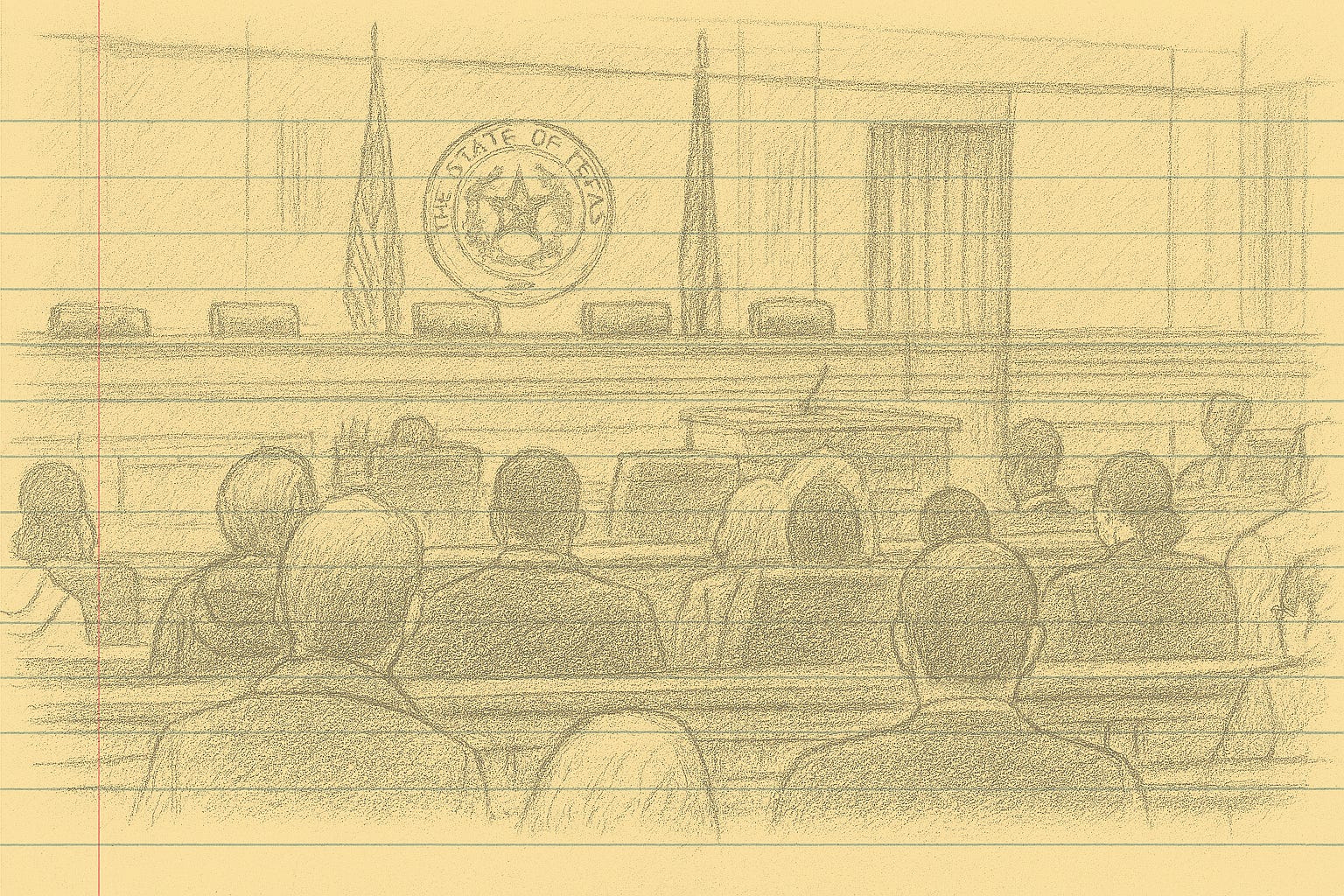
Texas Department of Public Safety v. Torres, No. 15-24-00089-CV (Brister, C.J., Field, Farris, JJ.): Reversing and remanding, the Fifteenth Court held that Sections 4312 and 4313 of the Uniformed Services Employment and Reemployment Rights Act (USERRA) govern initial reemployment after military service and do not restart when a service-related disability is discovered after the employee has already been reemployed. Here, the Texas Department of Public Safety promptly returned Torres to his trooper position after deployment, and his later request for accommodation based on a subsequently diagnosed disability could not support the reemployment jury charge submitted to the jury. But because the issue was novel and substantially clarified on appeal, the court remanded in the interest of justice rather than rendering judgment for DPS.
Argument
The Fifteenth Court has three arguments scheduled for May 21 at 9 am:
Frisco Summit, LP v. Frisco Multifamily Land GP, LLC, No. 15-25-00055-CV: Did the trial court properly grant summary judgment against Frisco Summit on its fiduciary-duty and related tort claims, enter take-nothing judgment on its contract claims, deny leave to amend, and award appellees attorney’s fees?
Appellants: Mitchell Madden (Holmgren Johson Mitchell Madden)
Appellees: Ryan Marrone (FBFK Law)
State v. Arity 875, LLC, Nos. 15-25-00082-CV, 15-25-00213-CV: Did the trial court properly grant the defendant’s special appearance in a case brought under the Texas Data Privacy and Security Act and Texas Data Broker Act?
Appellant: Clayton Watkins (Office of Attorney General)
Appellee: Reid Wittliff (Wittliff | Cutler)
In re Lau, No. 15-25-00219-CV: Is mandamus relief warranted from the trial court’s denial of the relator’s motion to transfer venue in a case involving a mandatory-venue provision under the Texas Health & Safety Code?
Relator: Alexander Wolf (Steptoe)
Real Party in Interest: Tevin Long (Office of Attorney General)
Red Light
Pencils down!
As always, I welcome your feedback and suggestions for 1910 & Beyond. Please don’t hesitate to leave a comment or email me with thoughts, topic ideas, or tips on interesting cases.
To the growing number of readers who have subscribed—thank you. If you haven’t yet, I hope you’ll consider joining—especially at the unbeatable cost of free. And if you know someone who might enjoy this content, I’d be delighted if you passed it along.
Until next time, have a great week—and here’s hoping your week is already well-outlined.
Thank you to my law firm, Hicks Johnson PLLC, for their support of 1910 & Beyond. Hicks Johnson is a premier trial and appellate boutique with offices in Houston and Chicago, known for delivering successful outcomes in high-stakes, complex litigation. We provide superior results for clients by combining elite legal talent and real courtroom experience with cutting-edge technology and strategic client collaboration.15
Congratulations to Chief Judge Elrod, the Conference Planning Committee, and the hardworking staff of the Fifth Circuit Clerk’s Office for putting together another fantastic conference.
Expect Novartis to seek mandamus review from the Supreme Court.
Disclaimer: I previously represented the appellees in the trial court.
For a sample of reactions from commentators on opposite sides of the spectrum, see these posts from Steve Vladeck and Josh Blackman.
Justice Sullivan did not participate in the decision.
Justice Hawkins did not participate in the decision.
Justices Lehrmann and Hawkins did not participate in the decision.
Justices Lehrmann and Devine did not participate in the decision.
Justice Bourliot authored the majority opinion, joined by Justice Spain. Justice Zimmerer dissented.
Judge Higginbotham authored the majority opinion, joined by Judge Southwick. Judge Jones concurred in part and dissented in part.
Judges Jones, Smith, Graves, Ho, Duncan, Englehardt, and Oldham voted in favor of rehearing. Chief Judge Elrod and Judges Stewart, Richman, Southwick, Haynes, Higginson, Willett, Wilson, Douglas, and Ramirez voted against rehearing.
Judge Haynes authored the majority opinion. Judge Dennis concurred in part and dissented in part. Judge Englehardt dissented.
Judge Graves authored the majority opinion, joined by Judge Higginson. Judge Wilson dissented.
In his always-insightful Adam’s Legal Newsletter Substack, Adam Unikowsky offers harsh criticism of the Fifth Circuit’s analysis.
Obligatory Disclaimer: This Substack is intended for informational purposes only and should not be construed as legal advice. The content provided does not constitute the formation of an attorney-client relationship. For advice specific to your situation, we recommend consulting with licensed legal counsel.
 | A guest post by
|