



Welcome back to 1910 & Beyond, your regular briefing on the ever-evolving world of appellate law in Houston and beyond. Each post spotlights notable developments from Houston’s two courts of appeals—the First and Fourteenth—as well as from other state and federal appellate courts across Texas and nationwide, while also sharing practical tips on oral and written advocacy. I hope you find these posts useful to your practice and your understanding of what’s happening in Texas appellate law.
To those who have already subscribed, thank you. If you haven’t yet, I hope you’ll consider joining us!
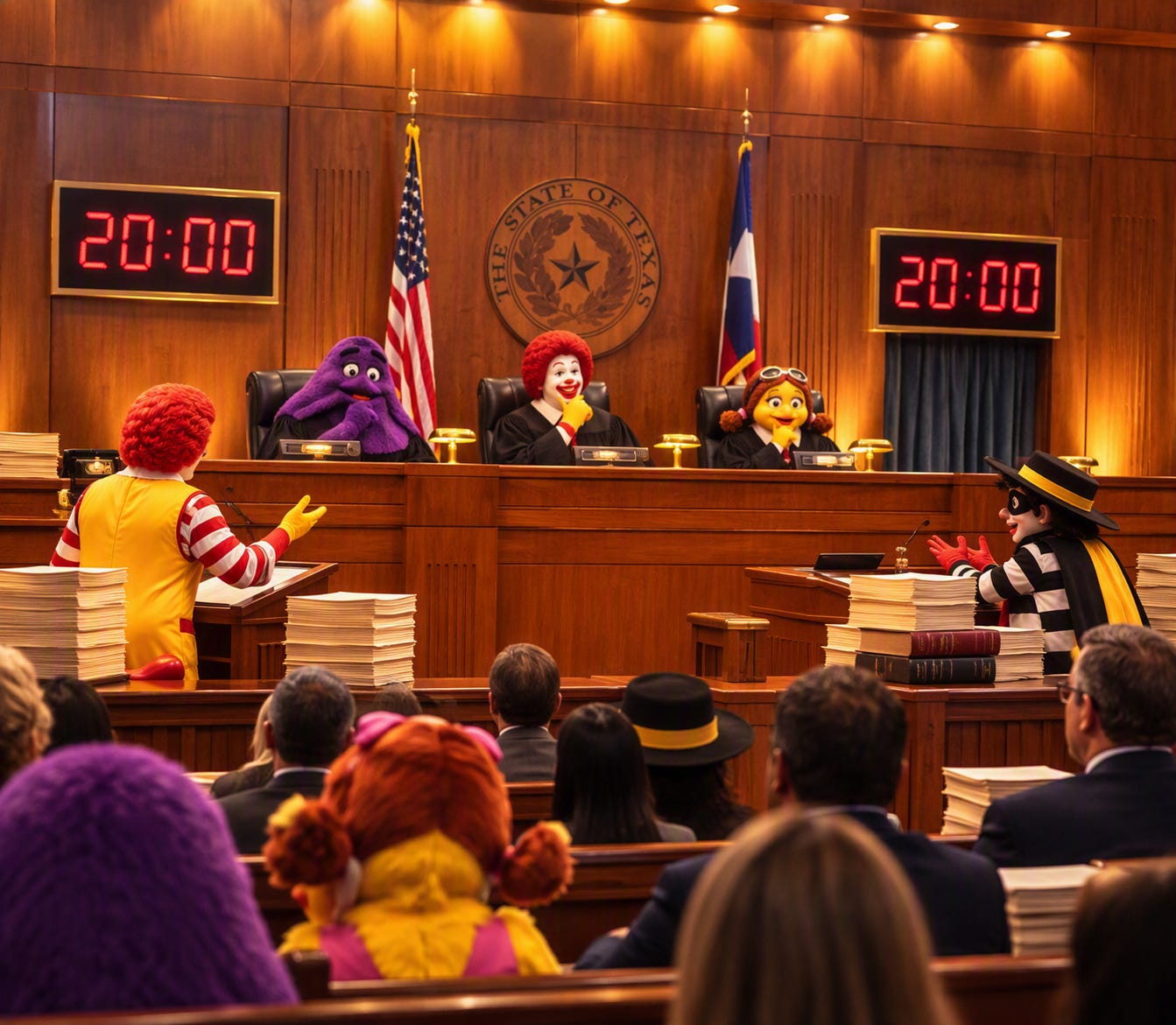
This week’s post is dedicated to our former colleague, Jordan Hill, who recently traded the law-firm life for a job beneath the Golden Arches. Jordan joined McDonald’s in-house team as Counsel, U.S. Strategic Initiatives. We’re not lovin’ losing him, but we’re excited to see what he cooks up next. (And if his strategic initiatives happen to include revealing the secret behind McDonald’s fries, at least one former colleague would appreciate a confidential briefing.)
Opening Statement
Store Manager’s Note: This week, Assistant Store Manager Fraser Holmes steps up to the counter with our Opening Statement. (Frankly, the fries are better when he’s in charge.)

Early in my career, we received an adverse summary-judgment ruling in a case I was working on. The partner on the matter asked me to research what came next. I poured through the Rules of Appellate Procedure and drafted a document with everything he could have hoped to know about the forthcoming appeal: Who we had to contact for the record, what our deadlines were, how long our briefs could be. I even included a guess on the timeline for resolution.
When I gave the research to the partner, he responded, “This is very helpful for the appeal. But what do we do about the judgment?”
My response that day did not inspire confidence, but it taught me a valuable lesson—Filing an appeal may be a necessary next step when you face an adverse judgment, but it’s not sufficient. You also need to know what to do to suspend the enforcement of the judgment while you pursue your appeal. Or, to use the proper term of art, you need to know how to supersede the judgment.
Texas’s supersedeas regime has changed significantly over the years, and its application can be subject to sharp disagreement among courts and jurists. For example, until this May, courts were divided on whether a $25 million cap on the amount required to supersede a money judgment applied per judgment, or per judgment debtor. Now, thanks to the Texas Supreme Court’s opinion in In re Greystar Development & Construction, L.P., we know that the cap applies per judgment debtor, providing critical guidance to courts and litigants alike.
But other questions remain, including one outlined in a recent statement from Justice Hawkins on the denial of a motion for rehearing in Greystar. As Justice Hawkins explained, large supersedeas bonds like the ones in Greystar also come with high administrative costs. Unlike a money judgment, however, an appellant cannot get these costs back on a favorable judgment. Not only do these costs make appeals more expensive, but they also risk resolving cases based on economic pressures to settle rather than a proper adjudication on the merits.
Justice Hawkins’s statement proposed an elegant and simple solution: Adopt the cost-shifting approach that is used in federal supersedeas procedure. In federal court—unlike in Texas—instead of requiring the appellant to front supersedeas bond costs in all instances, the costs of are borne by the party that ultimately loses on appeal. As I discussed on Hicks Johnson’s Perspectives page, adopting this approach would have three advantages.
First, requiring the appellate loser to bear the costs of a supersedeas bond accords with the venerable presumption that prevailing parties are always entitled to their costs. Second, adopting this cost-shifting approach better aligns economic incentives by discouraging parties from demanding large bonds in a case likely to be reversed and from pursuing weak appeals. And third, adopting this change would be relatively easy to implement: the Court need only amend Texas Rule of Appellate Procedure 4.3 to expressly include the costs of a supersedeas bond as taxable “costs” on appeal.
Ultimately, it remains to be seen whether Justice Hawkins’s suggestion will be adopted—either through legislation or through action by the Court—but we can expect that the rules and procedures around this critical part of post-judgment practice will continue to evolve. And hopefully, if or when you are presented with the question of what to do with an adverse judgment, you will have a better answer than I did.
1910
Orders and Opinions
And now, let’s see what’s on the local menu.Below are brief summaries of notable opinions and orders from Houston’s First and Fourteenth Courts.

1COA
Tran v. Overby, No. 01-23-00971-CV (Caughey, Morgan, Dokupil, JJ.): Affirming an attorney’s-fee award in a nonsuited divorce case, the First Court held that Overby’s pleaded counterclaim for fees incurred in defending the suit was an independent claim for affirmative relief that survived Tran’s nonsuit. Although the amount of reasonable fees under Family Code Section 6.708(c) is a fact question for a jury, the nonsuit extinguished Tran’s original jury demand, and the trial court could deny her later demand because she didn’t timely pay the jury fee.
Memorial Hermann Health System v. Freeman, No. 01-25-00220-CV (Adams, C.J.; Guiney, Johnson, JJ.): Affirming the denial of Memorial Hermann’s motion to dismiss, the First Court held that a patient’s claim arising from a rolling chair sliding out from under her at a hospital waiting room was not a health care liability claim requiring an expert report. As alleged, the petition didn’t establish a substantive connection between the accident and the hospital’s provision of health care; the alleged duties were instead ordinary premises-owner duties. And although the patient was seeking health care when she fell, that fact alone did not satisfy Memorial Hermann’s burden under the relevant Ross factors.
Alexander v. Ryse Investment, LLC, No. 01-25-00687-CV (Johnson, J.) (order): Striking Ryse Investment’s surreply brief filed without leave of court, the First Court explained that the appellate rules don’t permit a surreply as a matter of right.
Evermore Properties, LLC v. Impact Houston Church of Christ, No. 01-26-00109-CV (Gunn, J.) (order): In preparation for oral argument, the First Court requested that the parties file demonstrative exhibits: for one party, the PowerPoint slides it used at the temporary-injunction hearing; for another party, any other color graphics. The court explained that the exhibits wouldn’t alter the appellate record, but would assist its review of the record made below.
Foley & Lardner LLP v. Dernick, No. 01-25-00109-CV (en banc): Should the Court grant en banc reconsideration from the panel’s opinion in an arbitration dispute?
Order (per curiam): Motion denied by six-to-three vote. Chief Justice Adams and Justices Gunn, Caughey, Guiney, Morgan, and Johnson voted to deny reconsideration; Justices Rivas-Molloy, Guerra, and Dokupil voted to grant it.1
14COA
Gnadt v. Moody National Bank, No. 14-25-00283-CV (Hart, Boatman, Antú, JJ.): Affirming an order granting a bank’s judicial discharge as an estate’s executor, the Fourteenth Court held that Gnadt—the executor of a second estate—wasn’t entitled to statutory notice of the application for discharge because that second estate was no longer an “interested person” in the first estate. Under Section 22.018 of the Estates Code, an “interested person” is an heir, devisee, spouse, creditor, or other person that retains a pecuniary interest in the estate—not merely an heir, devisee, spouse, or creditor, as held by the Eastland and Texarkana Courts of Appeals—and the settlement agreement’s broad release extinguished any such interest held by the second estate. Because the evidence supporting Gnadt’s mutual-mistake theory wasn’t not admitted, the trial court didn’t abuse its discretion by denying her motion for new trial.
Homafar v. Rodriguez, No. 14-25-00618-CV (Wise, Wilson, Antú, JJ.): Reversing and remanding a summary judgment, the Fourteenth Court held that the defendants could not prevail on suicide as an affirmative defense because they had not pleaded it and the plaintiffs objected to it. The allegation that the decedent walked into oncoming traffic didn’t fairly plead suicide because it didn’t allege that he acted intentionally or sought his own death. And although the plaintiffs’ summary-judgment response was late, the order’s recital that the trial court considered “any responses” affirmatively showed that it permitted and considered the filing.
Gatesco, Inc. v. Ardon, No. 14-24-00799-CV (Christopher, C.J.; Wilson, Bridges, JJ.): Reversing and remanding for a new trial, the Fourteenth Court held that the apartment owner and manager were entitled to a proportionate-responsibility question concerning two men identified as participants in the assault that resulted in a tenant’s death. Police reports, eyewitness identifications, phone-location evidence, and unobjected-to testimony provided more than a scintilla of evidence that the two men committed the assault, making the refusal to submit them as responsible third parties harmful error. Finally, the decedent’s widow also had capacity to maintain the survival action because the estate-administration period had expired before the defendants challenged her capacity.
Griffiths v. LeafFilter North of Texas, LLC, No. 14-25-00004-CV (Christopher, C.J.; Wilson, Bridges, JJ.): Affirming a monetary sanction for failing to appear at court-ordered depositions, the Fourteenth Court held that the plaintiffs didn’t preserve their complaints about the absence of an evidentiary hearing or the scheduling of their depositions on a Sunday. They neither requested an evidentiary hearing nor objected to its absence, and mere references to attending church on Sundays didn’t specifically present a constitutional freedom-of-worship claim to the trial court.
Hess v. Sunbury Estates Community Improvement Association, No. 14-25-00699-CV (Christopher, C.J.; Hart, McLaughlin, JJ.): Affirming a Rule 91a dismissal, the Fourteenth Court held that res judicata barred the homeowners’ claims concerning subdivision maintenance, a burned house, and security patrols because those claims had been litigated in an earlier suit. As to the remaining claims, the homeowners failed to challenge every independent ground supporting their dismissal and inadequately briefed several claims. Finally, the HOA sufficiently supported its conditional appellate-fee request, and appellate sanctions against the homeowners were unwarranted because their brief raised legitimate potential grounds for reversal.
Arguments
1COA
Auto-Dril, Inc. v. National Oilwell Varco, L.P., No. 01-24-00046-CV (Caughey, Morgan, Dokupil, JJ.): Did the trial court err by granting summary judgment against Auto-Dril’s fraudulent-inducement claim on the ground that the parties’ settlement agreement released the claim and disclaimed reliance, even though the alleged misrepresentations were within the agreement itself?
Appellant: Greg White (Gray Reed)
Appellee: Michelle Blair (Ware Jackson Lee O’Neill Smith Barrow)
Argument: October 1 at 1:30 pm
In re Guardianship of Chaney, No. 01-25-00452-CV (Rivas-Molloy, Guerra, Gunn, JJ.): Did the probate court err by removing Chaney’s guardian on UTMB’s motion when UTMB allegedly lacked standing and the guardian allegedly didn’t receive the required service or notice?
Appellant: Josh Woods (Wright Close Barger & Guzman)
Appellee: Kevin Yankowsky (Norton Rose Fulbright)
Argument: October 7 at 2:30 pm
All arguments can be livestreamed here.
14COA
Certain Underwriters at Lloyd’s v. Aris Water Solutions, Inc., No. 14-25-00819-CV (Hart, McLaughlin, Antú, JJ.): Did the trial court err by holding that the well-control policy covered the costs of restoring the damaged well to its pre-failure condition, and did a claimed mismatch between that coverage ruling and Aris’s damages evidence preclude summary judgment on damages?
Appellants: William Boyce (Alexander Dubose Jefferson)
Appellee: Alan York (Reed Smith)
Argument: September 29 at 10 am
McLeod v. Sears, No. 14-25-00726-CV (Christopher, C.J., Jewell, Bridges, JJ.): In a largely sealed divorce dispute, did the trial court err by severing fraud claims from the pending divorce, compelling McLeod to arbitrate those claims as a nonsignatory to the governing partnership agreements, and refusing to stay the related divorce proceedings pending arbitration?
Appellant: Stephen Barrick (Hicks Thomas)
Appellee: Sameer Karim (Munsch Hardt Kopf & Harr)
Argument: September 29 at 2 pm
Houston Zoo, Inc. v. Piker, No. 14-25-00855-CV (Hart, McLaughlin, Antú, JJ.): Did the probate court err by holding that the trust agreement required the property to pass to the grantors’ heirs because the contingent charitable appointment never vested, and by alternatively refusing to apply the cy pres doctrine?
Appellant: Laine Weatherford (Hunton Andrews Kurth)
Appellee: Adrianne Graves (Graves Law)
Argument: October 8 at 2 pm
All arguments can be livestreamed here.
& Beyond
That does it for the local window. Now let’s pull forward to the & Beyond courts.
SCOTUS
As the Supreme Court’s summer recess winds down, election disputes remain on the emergency docket, including one case making its third trip to the Court in less than a month. Apparently, some customers really do come back for seconds (or thirds).

Opinions
Department of Homeland Security v. League of Women Voters, No. 26A308 (D.C. Circuit): Should the Court stay enforcement a district-court judgment that vacated the recently modified Systematic Alien Verification for Entitlements (SAVE) program?
Majority (per curiam): Yes. First, the plaintiffs’ claims that the SAVE program violates the Social Security Act and the Privacy Act lack merit because Congress has expressly authorized the Department of Homeland Security to seek citizenship and immigration status from the Social Security Administration under the Illegal Immigration Reform and Immigrant Responsibility Act (IIRIA). Second, this Court has “often granted certiorari where a lower court has set aside an important federal program.” And third, the Government has demonstrated it is likely to suffer an irreparable harm absent a stay because the district court’s order prevents it from using a program it believes is best suited to the task of “verifying the citizenship of voters.”
Dissent (Jackson, J., joined by Sotomayor and Kagan, JJ.): No. For starters, the Government misreads the relevant provisions in the IIRIA as overriding “explicit statutory grants on information-sharing” when these provisions merely “bar government entities or employees from interfering with otherwise lawful exchanges of citizenship information.” This reading is supported by the statutory structure, the IIRIA’s enactment history, contemporaneous Executive Branch practice, and “common sense.” Nor has the Government demonstrated irreparable harm: There is no harm in “setting aside” a program that violates federal law, and the majority ignores the harms that result from the continued operation of the modified SAVE program.
People Not Politicians v. Onder, No. 26A388 (Eighth Circuit): Should the Court stay a temporary restraining order implementing new congressional district maps?
Majority (per curiam): Still yes. No less now than the first time we stayed this case—without any noted dissents—the stay factors are not met. We have never held that the Constitution requires a state to use a primary map as its electoral map, and “[a]t this late date, ordering reversion to the 2025 map in the midst of an ongoing election would usher in electoral chaos.” And whatever objections the Eighth Circuit may have to the determination of the Missouri Supreme Court, the States decide election procedures subject to “limited constraints imposed by federal law.”
Orders
The Court’s only orders during the past two weeks were three stay denials in capital cases. But the Justices held their first conference of October Term 2026 yesterday, so the new Term’s first round of cert. grants should be arriving soon. We’ll have the full order in the next edition.
Arguments
Oral arguments return on October 5, when the Supreme Court begins a three-day stretch featuring four cases.
October 5
Suncor Energy (U.S.A.) Inc. v. Commissioners of Boulder County, No. 25-170 (Supreme Court of Colorado): Does federal law preclude state-law claims seeking relief for injuries allegedly caused by the effects of interstate and international greenhouse-gas emissions on the global climate? And does the Supreme Court have statutory and Article III jurisdiction to resolve the dispute?
Johnson v. United States Congress, No. 25-735 (Eleventh Circuit): Did the Veterans’ Judicial Review Act strip district courts of the jurisdiction to hear challenges to the constitutionality of acts of Congress affecting veterans’ benefits?
October 6
Anderson v. Intel Corp. Investment Property Committee, No. 25-498 (Ninth Circuit): Must a party pleading a claim under the Employee Retirement Income Security Act of 1974 (ERISA) based on a fund’s underperformance allege a “meaningful benchmark” when considering whether an ERIA fiduciary failed to use the requisite “care, skill, prudence, or diligence”?
October 7
Department of the Air Force v. Guahan, No. 25-579 (Ninth Circuit): (1) Is the federal government’s submission to a state or territorial regulator a renew a permit issued under the Resource Conservation and Recovery Act (RCRA) a “final agency action” that is immediately reviewable under the Administrative Procedure Act? (2) Must the federal government comply with the general environmental-review procedures of the National Environmental Policy Act of 1969 before submitting a permit-renewal application under RCRA?
All arguments can be livestreamed here.
SCOTX
The Austin menu features a little of everything: a per curiam reversal, two separate writings on denied petitions for review, and a GVR.
Opinion
Azhar v. Choudhri, No. 24-0939 (First Court) (no oral argument):2 Must a divorce decree issued by a Pakistani court be afforded comity when it was obtained unilaterally without any notice to the former spouse?
Majority (per curiam)3: No. Both the U.S. Supreme Court and this Court have explained that recognition of foreign judgments is not required. Instead, deciding whether to recognize a foreign judgment turns on a balancing of “international duty and convenience with the rights and protections of” domestic citizens. Recognition under the name of comity is particularly inapt where the foreign law is repugnant to Texas public policy. Proper notice is one such policy. Indeed, the requirement of proper notice is “a fundamental tenet of our justice system,” which in turn requires efforts of notice that reflect a true intent to find the counterparty and inform them of suit.
Orders
Beyond the standard denials lists and Justice Hawkins’s previously discussed statement in Greystar, two Justices wrote separately in connection with the denial of petitions for review.
Stewart Title Company v. Qualia Labs, Inc., No. 25-0686 (Fourteenth Court)4: Did the parties clearly and unmistakably delegate arbitrability of injunctive relief to the arbitrators when the contractual provision allowing for injunctive relief made no reference to arbitration rules?
Majority (per curiam): Petition for review denied.
Dissent (Busby, J.): I would have granted the petition. This Court has recognized that parties can limit the delegation of arbitrability issues to certain claims or controversies, but this case demonstrates the disagreement among our courts of appeals “on what limiting language is sufficient.” The contractual provision here presents a strong indication of the parties’ intent to have the courts resolve arbitrability issues—stronger, even, than past cases addressing this similar question. And while this Court has noted that parties can contractually limit the delegation of arbitrability issues, it hasn’t “offered any guidance on what contractual language could accomplish this goal.”
Richards v. Houston Classical, Inc., No. 25-1072 (Fourteenth Court)5: Are employees at open-enrollment charter schools “professionals” under Section 261.110(b) of the Texas Family Code?
Majority (per curiam): Petition for review denied.
Concurrence (Lehrmann, J.): I agree with the denial of the petition for review, but write separately to address two issues. First, there is mismatch between the general obligation to report child abuse and the statutory limitation that claims of retaliation for reporting abuse may only be asserted by “professionals.” This incongruence is “troubling” given our Legislature’s strong policy of protecting children from abuse. Second, while we haven’t directly addressed whether a common-law claim exists when an employee is fired for reporting suspected abuse without an instruction from the employer to not report the abuse, our precedent suggests such a common-law claim should be available “in some circumstances.”
Finally, the Court granted a joint GVR motion based on mootness:
Paris v. Texas, No. 25-0973 (Fifteenth Court): May the Texas Attorney General challenge the validity of voter-approved initiatives and certified by Texas municipalities?
Order (per curiam): Petition for review granted, judgment below vacated and dismissed as moot. But Petitioner’s request to vacate the court of appeals’ opinion is denied.6
Arguments
The Court’s October argument calendar is supersized: ten cases over three days, beginning October 6.
October 6
Lower Colorado River Authority v. Lost Pines Groundwater Conservation District, No. 24-0958 (Third Court): (1) Are proceedings concerning groundwater permitting conducted by the State Office of Administrative Hearings governed by the procedures outlined in the Texas Water Code or in the Administrative Procedure Act? (2) If the Water Code governs, did the petitioner timely file suit or subsequently cure any defect? (3) Does the court of appeals have appellate jurisdiction over an interlocutory appeal of an order denying a different party’s plea to the jurisdiction?
Petitioner: Amy Warr (Alexander Dubose Jefferson)
Respondents: William Christian (Dougherty Hearon & Moody) and Ryan Greene (Terrill & Waldrop)
Medina v. Texas Department of Transportation, No. 25-0429 (Fourteenth Court): Can an uncovered drainage opening in a grassy right-of-way near a pedestrian path qualify as a “special defect” under the Texas Tort Claims Act?
Petitioner: George Finney (Law Offices of Manuel Solis)
Respondent: Matthew Hilderbrand (Office of Attorney General)
In re Hughey, No. 25-0463 (Ninth Court) (orig. proceeding): Is mandamus relief appropriate from the trial court’s order striking the use of a non-stenographically recorded, artificial-intelligence-generated deposition transcript?
Relator: Bradley Snead (Wright Close Barger & Guzman)
Real Party in Interest: Stephanie Bryant (The Bays Firm)
Amicus Curiae Texas Deposition Reporters Association: Shelby O’Brien (Butler Snow)
Quantum Plus, LLC v. Hospital Internists of Austin, P.A., No. 25-0579 (Third Court): Are lost profits recoverable under a terminable-at-will contract, what control is prohibited by Texas’s corporate-practice-of-medicine doctrine, and how should courts handle attorney’s fees and tort damages after an election of remedies?
Petitioner: Jane Langdell Robinson (Langdell Robinson)
Respondent: Adam Pugh (Cagle Pugh)
October 7
Exxon Mobil Corp. v. Lexington Insurance Co., No. 25-0410 (Ninth Court): Do employee-injury exclusions in an umbrella insurance policy bar additional-insured coverage when the additional insured is alleged to be a statutory employer under the workers’ compensation laws?
Petitioner: Nicholas Bruno (Beck Redden)
Respondent: Thomas Wright (Wright Close Barger & Guzman)
Morath v. Texas State Teachers Association, No. 25-0527 (Third Court): Does an Education Commissioner rule giving an operating partner sole and final authority over employee assignments to an underperforming campus impermissibly impair teachers’ statutory rights?
Petitioner: Benjamin Mendelson (Office of Attorney General)
Respondent: Giana Ortiz (The Ortiz Law Firm)
Estate of Long, No. 25-0601 (Sixth Court): (1) What evidence is admissible to resolve a contest between a will’s intent and the court’s ability to carry out that intent? (2) Did the court of appeals err by failing to consider evidence that would have enabled it to carry out the decedent’s intent? And (3) did the court of appeals err in failing to render judgment based on a will’s residuary clause?
Petitioner: Kayla Oliver (Alexander Dubose Jefferson)
Respondent: Robert Gilbreath (Hawkins Parnell & Young)
In re Ford Motor Co., No. 25-0865 (First Court) (orig. proceeding):7 Is mandamus relief appropriate from the denial of Ford’s Rule 91a motion to dismiss claims arising from repairs performed by, and an alleged assault at, an independent dealership?In re Ford Motor Company, No. 25-0865
Relator: Elizabeth Brabb (Thompson, Coe, Cousins & Irons)
Real Party: Brian Cweren (Cweren Law Firm)
October 8
Texas Public Policy Foundation v. Highland Park Independent School District, No. 25-0759 (Fifth Court): (1) Should the Court revisit In re City of Georgetown and hold that the attorney-client privilege does not override the Texas Public Information Act’s disclosure requirements? (2) If attorney-client privilege generally overrides the Texas Public Information Act, may a governmental body invoke the privilege by commissioning a factual investigative report through an attorney instead of through the governmental body? (3) Is the privilege waived if a high-ranking employee discloses the findings for the government’s benefit?
Petitioner: Matthew Chiarizio (Texas Public Policy Foundation)
Respondent: Meredith Walker (Walsh Gallegos Kyle Robinson & De Los Santos)
San Patricio County Appraisal District v. Devon Gas Services, No. 26-0153 (Thirteenth Court), consolidated with San Patricio County Appraisal District v. Gunvor USA, LLC, No. 26-0157 (Thirteenth Court): Does the Import-Export Clause of the U.S. Constitution apply to petrochemicals exported out of Texas when the petrochemicals have a substantial nexus to Texas and are present in substantial qualities within Texas?
Petitioners: Kirk Swinney (Low Swinney Evans & James)
Respondents: Daniel Durrell (Troutman Pepper Locke)
All arguments can be livestreamed here.
CA5
Austin’s in the bag. Now we’re off to New Orleans to check out the Fifth Circuit location.

Opinions
Megalomedia Inc. v. Philadelphia Indemnity Insurance Co., No. 23-20570 (Ho, Duncan, Oldham, JJ.): Did Megalomedia forfeit its argument that “reality show” was ambiguous by repeatedly describing My 600-lb Life as a reality show in the district court?
Majority (Duncan, J., joined by Ho, J.): Yes. Affirming judgment for the insurer, the Fifth Circuit held that Megalomedia forfeited its ambiguity argument by raising it for the first time on appeal after repeatedly taking the opposite position below. The district court also correctly rejected Megalomedia’s fraud and statutory claims because the evidence showed that it knew the policy excluded reality shows, treated My 600-lb Life as one, and therefore couldn’t justifiably rely on any contrary representation about coverage.
Concurrence (Ho, J.): Yes. Megalomedia’s reversal justified applying forfeiture because changing positions between the district court and appeal wastes judicial resources and undermines party presentation. And counsel deserves credit for candidly acknowledging the forfeiture problem, exemplifying the same candor courts and judges—no less than government agencies or corporations—owe when changing positions.
Dissent (Oldham, J.): No. Party presentation governs claims, not every legal argument supporting a properly presented claim, and courts retain independent authority to identify and apply the governing law. Because Megalomedia consistently sought coverage under the policy, it could argue on appeal that the undefined term “reality show” was ambiguous, and Texas law required resolving that ambiguity in the insured’s favor.
East Fork Enterprises, Inc. v. EPA, Nos. 24-60227, 24-60256 (Higginbotham, Jones, Southwick, JJ.): Vacating the EPA’s methylene-chloride rule and associated risk determination, the Fifth Circuit held that the agency exceeded its authority under the Toxic Substances Control Act by assessing the chemical’s risk as a whole rather than separately evaluating each condition of use, and by assuming without substantial evidence that workers didn’t use personal protective equipment. The EPA’s acute and chronic exposure limits also relied on excessively conservative assumptions, selectively discounted contrary human studies, and failed to reflect the statute’s “unreasonable risk” standard. The agency further exceeded the regulation “necessary” to eliminate unreasonable risk by largely prohibiting MC without adequately considering economic consequences or technically and economically feasible alternatives. And the Sierra Club’s separate challenges lacked merit or standing.
Harward v. City of Austin, No. 25-50160 (Willett, Engelhardt, Douglas, JJ.): Reversing and remanding, the Fifth Circuit held that Pullman abstention didn’t apply to shoreline homeowners’ federal equal-protection claim alleging that the City of Austin taxed their properties as within its full-purpose jurisdiction while denying them the municipal services provided to other full-purpose residents. That federal claim didn’t depend on resolving disputed questions of Texas law about the properties’ jurisdictional status, and a new statutory disannexation mechanism didn’t moot the case because it neither refunded the challenged taxes nor automatically disannexed every property. And given the length of the case’s pendency, the district court must address the City’s remaining grounds for dismissal together on remand.
Elite Precision Customs L.L.C. v. Bureau of Alcohol, Tobacco, Firearms, and Explosives, No. 25-11206 (Smith, Haynes, Engelhardt, JJ.): Do those provisions of 18 U.S.C. 922 “that collectively prohibit the buying and selling of handguns across state lines” violate the Second Amendment?
Majority (Smith, J., joined by Engelhardt, J.): Yes. Under Bruen Step 1, the provisions implicated the Second Amendment’s plain text because the right to keep arms necessarily encompasses the right to purchase them, and the availability of dealer-to-dealer transfers did not change the provisions’ categorical prohibition of direct interstate purchases. And under Bruen Step 2, the Government’s proposed historical analogues concerned wartime defense, foreign or tribal commerce, or product regulation, rather than peacetime restrictions on firearms transactions between residents of different states. Or, more simply: “The Ban sullies the plain text of the Second Amendment and is inconsistent with the nation’s tradition of firearms regulation, dating back to the founding era, under that Amendment.”
Dissent (Haynes, J.): No. “I agree with the district court’s decision that the several provisions of 18 U.S.C. § 922 discussed in this case are not unconstitutional under the Second Amendment. That is all that is in play in this case, thus, I would affirm.”
Arguments
The Fifth Circuit’s October argument session runs from October 6 through 9, with three panels sitting in New Orleans.
All arguments can be livestreamed here.
15COA
One final item on our appellate order: two opinions from the Fifteenth Court and a college-athletics dispute headed its way.
Opinions
CreateAI Holdings, Inc. v. Bot Auto TX Inc., No. 15-25-00001-CV (Brister, C.J.; Field, Farris, JJ.): Affirming the denial of a temporary injunction in a trade-secrets dispute involving autonomous-trucking technology, the Fifteenth Court held that some evidence supported the trial court’s determination that CreateAI had not shown a probable right to recover or a probable, imminent, and irreparable injury. CreateAI had publicly disclosed its external sensor array, Bot Auto’s decision-making system used a materially different neural-network architecture, and the companies’ braking and steering technologies differed in significant respects. CreateAI’s “steer” away from autonomous trucking also supported the conclusion that any lost licensing revenue could be adequately compensated through damages.
Beckcom v. Texas A&M University, No. 15-25-00124-CV (Brister, C.J.; Field, Farris, JJ.): Affirming in part and reversing and remanding in part, the Fifteenth Court held that Texas A&M failed to justify withholding documents concerning DEI initiatives because it presented neither the documents for in camera review nor affidavits explaining how the claimed Public Information Act exception applied. Reliance on an earlier attorney-general decision didn’t establish that the documents were properly withheld because the correctness of that decision remained subject to judicial review. But the University properly withheld documents concerning a Corps of Cadets investigation because its determination that the records contained personally identifiable student information protected by FERPA wasn’t subject to judicial review.
Order
College athletics have reached the Fifteenth Court—though sadly not through the now-moot Brendan Sorsby saga, which prompted the Big XII to sue Texas Tech. The Court instead granted a petition for permissive appeal in National Collegiate Athletic Association v. State, No. 15-26-00135-CV. The interlocutory appeal involves a since-superseded NCAA policy on transgender athletes and will test the DTPA’s reach, whether the State’s challenge presents nonjusticiable political questions, and whether the claims are moot. Keep an eye on this one.
Argument
No arguments on the Fifteenth Court’s menu this week.
Red Light
That completes our order!

As always, I welcome your feedback and suggestions for 1910 & Beyond. Please don’t hesitate to leave a comment or email me with thoughts, topic ideas, or tips on interesting cases.
To the growing number of readers who have subscribed—thank you. If you haven’t yet, I hope you’ll consider joining—especially at the unbeatable cost of free. And if you know someone who might enjoy this content, I’d be delighted if you passed it along.
Until next time, have a great week—and Jordan, if you’re reading, watch out for the Hamburglar.
Thank you to my law firm, Hicks Johnson PLLC, for their support of 1910 & Beyond. Hicks Johnson is a premier trial and appellate boutique with offices in Houston and Chicago, known for delivering successful outcomes in high-stakes, complex litigation. We provide superior results for clients by combining elite legal talent and real courtroom experience with cutting-edge technology and strategic client collaboration.
Kudos to the First Court for the transparency in identifying the vote breakdown, similar to the Fifth Circuit.
Justice Guerra authored the First Court’s opinion, joined by Chief Justice Adams and Justice Farris.
Justices Huddle and Young did not participate in the decision.
Justices Jewell, Bridges, and Antú comprised the Fourteenth Court panel that issued a per curiam memorandum opinion.
Justice Antú authored the Fourteenth Court’s opinion, joined by Justices Bridges and Boatman.
Justice Sullivan did not participate in the decision.
Chief Justice Adams and Justices Morgan and Dokupil comprised the First Court panel that summarily denied the petition.